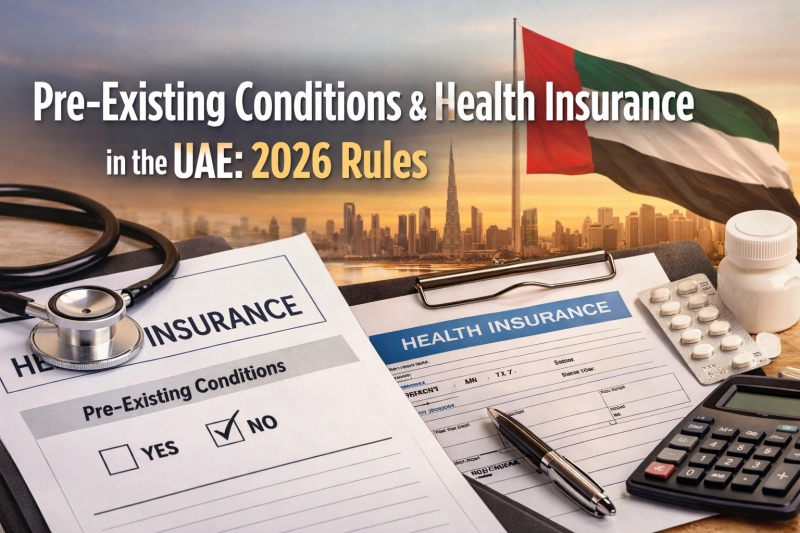
A pre-existing condition is generally any illness, symptom, injury, or medical issue that existed (or was treated, diagnosed, or medically suspected) before your health insurance policy start date.
In the UAE, pre-existing conditions matter because they influence:
- Whether the insurer will accept your application as standard
- Whether your condition will be covered immediately, covered after a waiting period, covered with limits, or excluded
- Whether your premium may be adjusted based on medical risk
Pre-existing conditions are not limited to major diagnoses. They can include chronic conditions (for example, diabetes or hypertension), previous surgeries, ongoing medications, recurring symptoms, and sometimes even pending investigations.
The most important rule from a consumer perspective is simple: full disclosure protects you. Non-disclosure can lead to claim delays, denial, or cancellation depending on policy terms.
UAE Health Insurance Rules for Pre-Existing Conditions (2026 Update)
Health insurance in the UAE is regulated and implemented through emirate-level health systems (such as Dubai and Abu Dhabi frameworks) and insurer underwriting rules. As of 2026, the practical “rules” you will experience as a customer typically come from three layers:
- Local health authority requirements (the minimum benefits and compliance rules depend on the emirate and plan category)
- Insurer underwriting and policy wording (what the insurer agrees to cover, when, and under which conditions)
- Network and TPA rules (how approvals, direct billing, and claims are processed)
What this means in real life is that pre-existing conditions are commonly handled through one (or a mix) of these approaches:
- Coverage after a waiting period
- Coverage with sub-limits or specific caps for certain conditions
- Coverage with co-insurance/co-pay requirements
- Temporary or permanent exclusions (more common in certain plan types, and more likely for high-cost conditions)
If you want to cross-check official healthcare system information, you can refer to the relevant authority for your emirate, such as the Dubai Health Authority (DHA) for Dubai or the Department of Health Abu Dhabi for Abu Dhabi.
Waiting Period for Pre-Existing Conditions in the UAE
A waiting period is a set time after your policy starts during which the insurer may not cover treatment related to declared pre-existing conditions (or may cover it only in limited situations).
In the UAE market, waiting periods for pre-existing conditions are common, especially on individual and SME policies. The exact duration is not universal and depends on:
- The insurer and plan category
- Whether you are buying an individual plan or joining a group plan
- Your medical history and supporting documents
- Whether you had continuous coverage with no major breaks
In practice, many UAE policies apply a waiting period that is often measured in months, but the only reliable answer is always the policy schedule and wording for the plan you are buying.
Which Pre-Existing Conditions Are Usually Covered?
Coverage decisions are case-by-case, but many pre-existing conditions can be covered in the UAE when:
- They are properly declared during application
- The insurer accepts them under standard or special terms
- The waiting period (if any) is completed
- Treatment follows medical necessity and network rules (pre-approvals where required)
Common examples of conditions that are frequently covered under managed terms include:
- Stable, controlled chronic conditions (for example, hypertension) under ongoing medication
- Asthma or allergies when well-documented and not associated with frequent hospitalisations
- Thyroid disorders with stable treatment history
The key is documentation. If you can provide recent medical reports, prescriptions, lab results, and a clear timeline, underwriting becomes faster and the outcome is usually clearer.
Conditions Commonly Excluded or Restricted
Even in 2026, some conditions can be restricted or excluded depending on severity, cost, and the plan level. Restrictions typically appear as:
- Exclusion of a specific condition or its complications
- Sub-limits for related investigations, procedures, or medicines
- Higher co-pay for certain services
Examples of conditions that may trigger tighter underwriting (not an automatic exclusion) can include:
- Complex cardiac history or recent cardiac procedures
- Cancer history or ongoing oncology treatment
- Severe autoimmune disorders requiring high-cost biologic medicines
- Advanced kidney disease or dialysis history
- Significant mental health history requiring ongoing specialist care
Because these outcomes are insurer-specific, “excluded” does not always mean “uninsurable”. Often it means you need the right insurer match, better documentation, or a different plan tier.
How Insurers Assess Pre-Existing Conditions
Insurers generally assess pre-existing conditions through underwriting. In practical terms, underwriting evaluates medical risk using:
- Your application disclosure (health declaration)
- Past medical reports, discharge summaries, and diagnostic results
- Current medications and treatment frequency
- Any history of complications, hospital admissions, or surgery
- Lifestyle factors (for example, smoking) where relevant
You may also be asked for:
- A medical questionnaire for a specific condition
- Additional lab tests or doctor reports (especially for higher-sum insured plans)
A helpful way to think about underwriting is that insurers are trying to answer two questions:
- Is this risk predictable and manageable within the plan pricing?
- Can the policy wording clearly define what is covered, when, and how?
The clearer your documents, the faster you get a decision.
Pre-Existing Conditions for New UAE Residents
If you are a new UAE resident (or returning after a long gap), pre-existing conditions can feel like the biggest barrier to getting compliant medical insurance.
Here is what typically helps most in the UAE market:
- Apply early (do not wait until the last minute around visa or employment deadlines)
- Prepare a medical file: recent doctor notes, medication list, test results, and any hospital discharge summary
- Be consistent: ensure names, dates, and passport/Emirates ID details match across documents
- Explain stability: if your condition is controlled, documentation showing stable readings and regular follow-up supports better terms
If you have had insurance in another country, you can still share prior coverage details, but the insurer’s decision will usually rely more on medical evidence and UAE policy terms than on foreign policy wording.
Switching Health Insurance with a Pre-Existing Condition
Switching insurers can be a smart move if your premium increases sharply at renewal, your network no longer fits your needs, or your employer changes.
However, with a pre-existing condition, switching requires extra care because:
- A new insurer may apply a new waiting period (depending on their rules and the continuity of coverage)
- Benefits can change (different networks, different pre-approval rules)
- The way your condition is covered can shift from “standard coverage” to “coverage with limits” or vice versa
Before switching, it helps to compare your current and new plan side-by-side on:
- Coverage for your specific condition (including medicines)
- Waiting period and any special terms
- Network hospitals and clinics you actually use
- Pre-approval requirements for specialist visits, diagnostics, and procedures
Never cancel your current plan until the new policy is issued and active, especially if you have ongoing treatment.
Common Mistakes to Avoid
Most pre-existing condition problems are not caused by the condition itself, but by process and paperwork issues.
Avoid these common mistakes:
- Not disclosing a condition because you are worried about rejection (this can backfire at claim time)
- Assuming “covered” means “covered immediately” (waiting periods and pre-approvals are separate issues)
- Buying only based on premium and ignoring exclusions, sub-limits, and co-pay structure
- Letting your policy lapse during renewal (which can complicate continuity and approvals)
- Submitting incomplete documents (missing dates, missing diagnosis notes, unclear medication history)
If you are unsure how to disclose something, it is safer to disclose it with documents than to omit it.
How InsuranceHub.ae Helps with Pre-Existing Conditions
Pre-existing conditions require more than just an online checkout. You need the right insurer match, correct disclosure, and a plan that works with your network and approvals.
InsuranceHub.ae helps by:
- Letting you compare health insurance quotes in the UAE across multiple insurers, so you are not forced into one underwriting outcome
- Providing expert advisor recommendations to shortlist plans that are more realistic for your medical profile
- Supporting you with document guidance, so your application is complete the first time
- Explaining practical plan differences like waiting periods, exclusions, and sub-limits before you commit
- Assisting after purchase with online claim assistance, especially when approvals or paperwork create delays
If you are dealing with a pre-existing condition and want to avoid wasted time, you can start with InsuranceHub’s platform to compare options and speak to an advisor: InsuranceHub.ae.