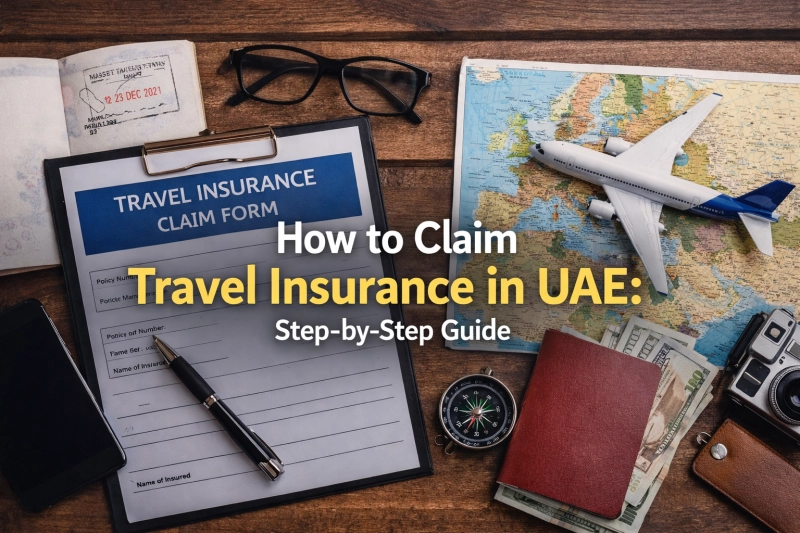
Travel insurance only proves its value when something goes wrong, a medical emergency abroad, lost baggage, trip cancellation, or a flight delay that triggers extra expenses. If you live in the UAE, the smoothest travel insurance claim usually comes down to three things: notifying the insurer early, collecting the right documents, and following the insurer’s exact submission rules.
What Is Travel Insurance and What Does It Cover?
Travel insurance is a short term policy designed to protect you against specific financial risks during a trip. Coverage depends on the plan, but many UAE travel policies commonly include:
- Emergency medical treatment abroad (hospitalization, doctor visits, prescribed medicines)
- Emergency medical evacuation or repatriation (if medically necessary and covered)
- Trip cancellation or curtailment (covered reasons only)
- Travel delay (when delay exceeds the policy threshold)
- Baggage loss, theft, or delay
- Personal liability (in some plans)
Always check your policy wording for key restrictions such as pre existing condition clauses, excluded activities (some adventure sports), alcohol related incidents, and destination limitations.
When Can You File a Travel Insurance Claim?
You can file a travel insurance claim when:
- The event is covered under your policy
- The event happens during the insured travel period
- You can provide proof and documents that match the insurer’s requirements
- You submit within the insurer’s notification and submission timelines
If you are unsure whether your situation qualifies, notify the insurer anyway. Late notification is a common reason for claim disputes.
Common Reasons for Travel Insurance Claims in the UAE
UAE residents and expats most often claim travel insurance for:
- Emergency medical care overseas, including hospital admissions
- Flight delays leading to extra hotel, meals, or rebooking costs
- Trip cancellation due to covered emergencies
- Lost luggage or delayed baggage
- Theft of passports or personal items, typically requiring a police report
Step-by-Step Process to Claim Travel Insurance in UAE
Most insurers follow a similar structure: notify, document, submit, validate, and settle. The exact portal and forms vary, but the logic stays the same.
Step 1: Inform Your Insurance Provider Immediately
Notify your insurer (or assistance helpline) as soon as a covered incident happens, especially for medical emergencies.
Do this early because:
- Some medical claims require pre authorization for hospital admission.
- The insurer may direct you to network facilities (where applicable).
- The insurer can tell you exactly which documents to collect.
If you bought through InsuranceHub.ae, you can also request guidance on the right claim route (cashless support vs reimbursement), based on your policy and insurer.
Step 2: Collect All Required Documents
Start collecting documents immediately, while you are still at the hospital, airport, or hotel. Missing paperwork is the number one reason for delays.
For medical claims, also ask for itemised invoices, medical reports, and proof of payment. For baggage claims, request written confirmation from the airline (for example, a property irregularity report).
Step 3: Fill and Submit the Claim Form
Complete the insurer’s claim form carefully. Small errors can cause long back and forth follow ups.
Focus on:
- Correct policy number and insured details
- Accurate incident date and location
- Clear description of what happened
- Matching amounts (claim form vs receipts)
If the insurer provides both online and offline options, online submission is usually faster and easier to track.
Step 4: Provide Supporting Evidence
Insurers do not only pay because you reported an event, they pay when you prove the event is covered.
Supporting evidence can include:
- Medical reports, discharge summary, prescriptions
- Boarding passes and booking confirmations
- Delay notifications from airlines
- Police report for theft
- Proof of payment (card slip, bank statement, receipt)
If you are a frequent traveller, consider keeping a baseline health record so you can separate pre existing issues from new events. Some people use lab services such as biomarker testing and longevity programs to maintain organized clinician reviewed reports, which can be helpful when insurers request medical context (your policy rules still apply).
Step 5: Track Your Claim Status
After submission, track your claim status through the insurer’s portal, email updates, or customer support.
To keep things moving:
- Respond quickly if the insurer asks for clarifications
- Keep a single folder with all files (PDFs and photos)
- Save reference numbers and emails
If you need help organising documentation or understanding what the insurer is asking for, Insurancehub.ae can assist with general claim guidance and coordination (final settlement decisions remain with the insurer and policy terms).
Documents Required for Travel Insurance Claims
Document requirements vary by insurer and claim type, but the list below covers what is most commonly requested.
| Claim type | Common documents |
|---|---|
| Medical expenses | Claim form, medical report, itemised invoice, receipts/proof of payment, prescription, travel dates proof |
| Trip cancellation | Claim form, booking confirmations, cancellation invoice, proof of covered reason (medical certificate or other evidence) |
| Flight delay | Claim form, airline delay confirmation, boarding pass, receipts for extra expenses |
| Baggage loss/theft | PIR/airline report, police report (if theft), baggage tags, receipts or proof of ownership (if required) |
| Passport theft | Police report, consulate documents, receipts for emergency expenses (if covered) |
Tip: take clear photos of every document and keep originals. Some insurers ask for original receipts for reimbursement.
How Long Does a Travel Insurance Claim Take in UAE?
Claim timelines vary based on:
- The complexity of the case (medical vs simple delay)
- How complete your documents are
- Whether the insurer needs third party verification
- Whether additional medical review is required
Simple claims ( like a documented flight delay ) may be processed faster than medical reimbursement claims that require clinical assessment. The best way to reduce timelines is to submit complete, legible documents the first time.
Common Reasons for Claim Rejection
Travel insurance claims are commonly rejected due to:
- The event is excluded (for example, excluded activities or excluded destinations)
- Late notification or late submission beyond policy timelines
- Missing documents (no police report, no airline report, no medical report)
- Pre existing condition limitations (policy dependent)
- Non disclosure or inconsistent information across documents
- Costs not eligible (for example, non covered upgrades, undocumented expenses)
If you are unsure, check the exclusions and the claims section in the policy wording before escalating.
Tips to Ensure a Smooth Travel Insurance Claim
Most successful claims follow a disciplined approach.
- Call the assistance line first for medical incidents, do not self manage large hospital bills without guidance.
- Ask for item invoices and clear medical notes.
- Keep receipts for every expense you expect to claim.
- Get official reports (airline, police, hotel) while you are still on site.
- Write a short incident summary with dates and times, it helps if you submit weeks later.
Can You Claim Travel Insurance Online in UAE?
In many cases, yes. Many insurers operating in the UAE allow online claim submission through:
- Insurer websites and claim portals
- Mobile apps
- Email submission (with scanned documents)
Online claims are usually easier to track and reduce the chance of lost paperwork. Still, always keep originals, especially for receipts.
What to Do If Your Claim Is Rejected
If your claim is rejected:
- Request the rejection reason in writing.
- Compare it against the policy wording (definitions, exclusions, timelines).
- Check if the issue is fixable (missing document, unclear invoice, wrong form).
- Submit an appeal or reconsideration if the insurer provides a process.
If you purchased through Insurancehub.ae, you can also ask for support to understand which document or clause triggered rejection, so you can respond with the right evidence.
Final Thoughts on Travel Insurance Claims in UAE
A travel insurance claim is mainly a documentation exercise. The more clearly you prove that an event happened, that it falls within the insured period, and that it is covered, the smoother the outcome.
If you have an upcoming trip and want to reduce claim headaches later, start by choosing a plan with clear medical limits, strong assistance support, and claim friendly documentation rules. You can compare options and request guidance through InsuranceHub’s online travel insurance process.